
Brands We Serve

logo-apple

logo-nasa

logo-aligned-energy

logo-los-alamos

logo1

Toyota-logo

logo6

logo8

logo2

logo9

logo4

logo10

logo5

IT23-IMBA2-030416-company-1

Logo_for_Orbital_ATK

VW-Logo_Tagless_Shawblue_H-1
Humidity Failure in a Ripening Room Is a Product Loss Event
Ripening rooms are engineered environments. Temperature, ethylene concentration, airflow, and humidity are all controlled variables that determine whether produce arrives at peak condition or arrives degraded. Of these, humidity is the variable most likely to be under-specified.
Too low and produce loses moisture through transpiration, shrinking below acceptable weight and grade thresholds before it reaches the retailer. Too high and condensation risk increases, creating surface moisture conditions that accelerate mold and bacterial growth. The tolerance window is narrow, and it has to be held continuously across the full ripening cycle, which in some facilities runs 24 to 96 hours per chamber load.
The second problem is equipment. Cold storage environments are demanding for humidification systems. Temperature differentials, high-moisture air, and continuous operation put pressure on transducers, controls, and water delivery components. A system that works at commissioning but degrades over time under cold storage conditions creates a maintenance burden at exactly the wrong moment: when the chamber is loaded, and the cycle is running.
Humidity Held to Setpoint, from First Load to Last
UltraPure pairs RODI water purification with industrial ultrasonic humidification to deliver precise, continuous humidity control in cold storage and ripening room environments. RODI-purified water protects the transducer from mineral fouling, extends equipment service life in a demanding operating environment, and ensures the mist entering the ripening space is clean water vapor rather than mineralized particulate.
Setpoint Held Continuously Through the Full Ripening Cycle
Proportional control with dynamic proportional adjustment modulates humidifier output in real time, tracking the RH setpoint through temperature fluctuations, load changes, and the ambient variation that comes with continuous cold storage operation. The system does not wait for RH to drop before responding. It adjusts output proactively to hold the setpoint without overcorrection.
Produce Shrink Controlled at the Source
Moisture loss through transpiration is a direct function of vapor pressure deficit between the produce surface and the surrounding air. Maintaining target RH reduces that deficit, slowing transpiration and limiting weight loss. For large-volume cold storage operations, the margin difference between controlled and uncontrolled humidity translates to measurable reduction in shrink and grade-out across every load cycle.
Equipment Designed to Run in Cold Storage Conditions
UltraPure humidifiers are built for continuous commercial operation, not adapted from lighter-duty applications. RODI-purified water means no mineral accumulation fouling transducers over time in a high-cycle cold storage environment. Patented cabinet designs protect system components. Maintenance is reduced to scheduled filter replacement at a predictable interval.
From Water Source to Ripening Room: How the System Works
Step 1: Water Purification
Feed water enters the UltraPure RODI system. Multi-stage reverse osmosis and deionization remove dissolved minerals, chlorine, and contaminants to near-zero TDS. In a cold storage environment, this step is particularly important: mineral accumulation in transducers accelerates under high-cycle operation, and purified water is what sustains long-term performance.
Step 2: Ultrasonic Atomization
Purified water feeds to the industrial ultrasonic humidifier. High-frequency transducers produce a fine, clean mist at ambient temperature: no heat addition to the cold storage environment, no steam, no thermal interference with the temperature control system.
Step 3: Proportional Humidity Control
Variable speed fans and proportional control with dynamic proportional adjustment regulate output in real time. The system maintains RH setpoint continuously through the ripening cycle, adjusting to changes in thermal load, chamber conditions, and ethylene concentration without manual intervention.
Step 4: Consistent Operation Across Every Load Cycle
Once commissioned, the system holds its setpoint load after load. No transducer fouling from mineral buildup. No performance degradation requiring mid-cycle intervention. Filter replacement on a scheduled interval is the primary maintenance task.
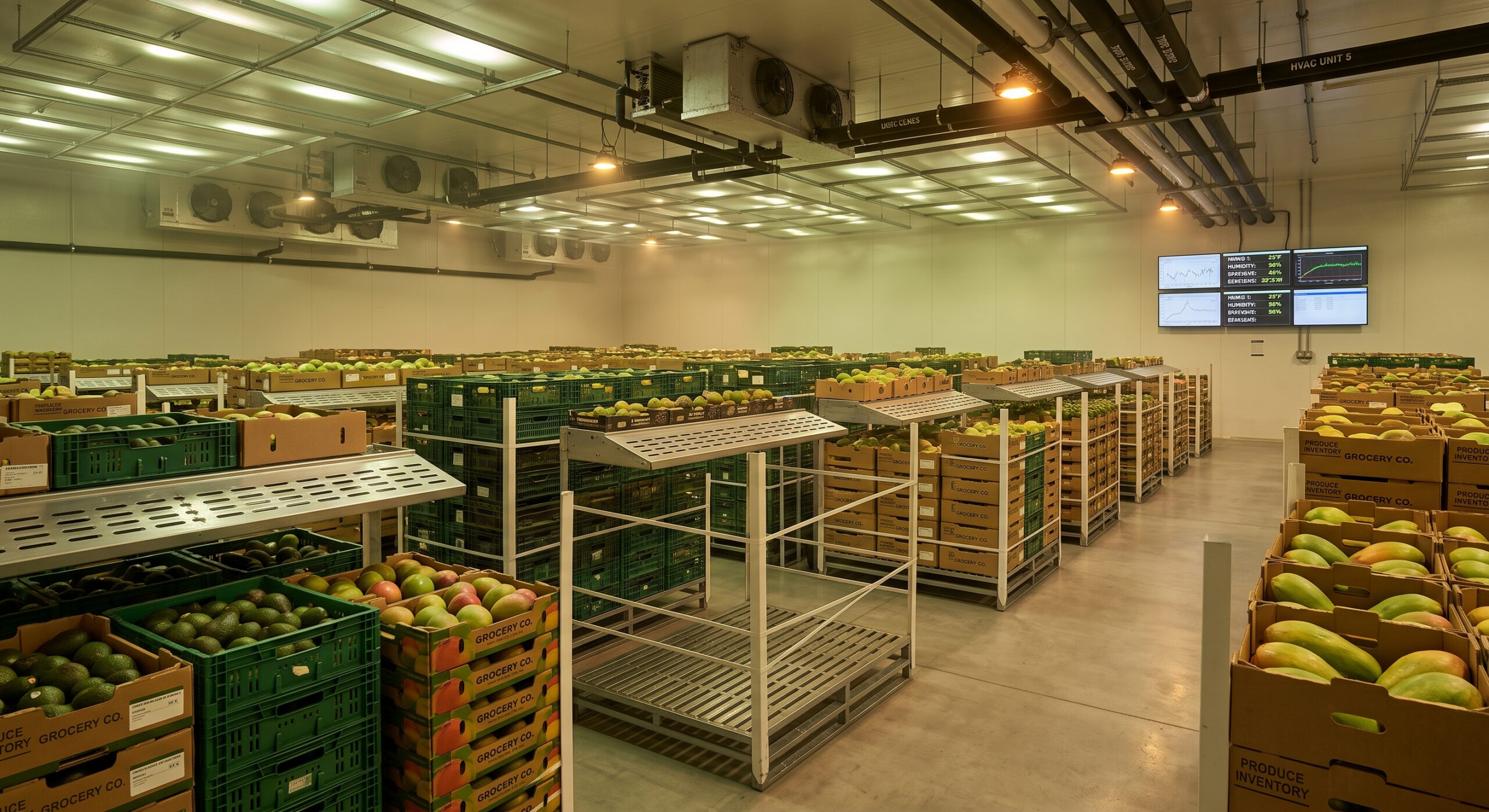
Systems Sized for Single-Chamber Ripening Rooms Through Large-Scale Cold Storage Facilities
UltraPure RODI cabinets range from 75 GPD to 7,500 GPD. Humidifier capacity is matched to chamber volume, target RH setpoint, and the thermal conditions specific to cold storage environments. Whether you are specifying a single ripening room or a multi-chamber commercial cold storage facility, the system is sized to the load.
What you get:
- RODI purification matched to humidifier flow demand
- Ultrasonic humidification with no heat addition to the controlled environment
- Proportional and dynamic proportional humidity control for continuous setpoint maintenance
- Variable speed fans for precise output modulation across changing chamber conditions
- Patented cabinet design: compact, wall-mounted, field-serviceable (US D780,884 S / US D780,885 S)
- Direct wall-mount installation, no external control box required
- Replacement filters cataloged by system model (no cross-referencing required)
- Made in the USA
Why Ultrasonic Is the Right Humidification Technology for Cold Storage Environments
Steam humidification adds heat, which directly conflicts with the temperature control requirements of a ripening room or cold storage facility. Every BTU of heat a steam humidifier introduces is a BTU the refrigeration system must remove. That thermal load increases energy consumption and places additional demand on cooling infrastructure that is already running continuously.
Evaporative humidification responds slowly to setpoint deviation and struggles to maintain precise RH in cold, low-vapor-pressure environments where saturation capacity is limited. Response lag means the system overshoots or undershoots the setpoint, and the tolerance window in a ripening room is too narrow for that kind of variability.
Ultrasonic humidification operates at ambient temperature, adds no heat load to the refrigerated space, and responds rapidly to control signals through proportional output modulation. In cold storage environments, where both temperature and humidity are tightly controlled and interact with each other, a humidification technology that does not interfere with the thermal environment is the correct specification. RODI-purified water removes the only historical objection to ultrasonic in cold environments: mineral particulate settling on produce surfaces.
Common Questions from Cold Storage and Ripening Room Engineers
Q: Does ultrasonic humidification add heat load to the ripening room?
A: No. Ultrasonic atomization operates at ambient temperature through high-frequency transduction. It does not boil water and produces no heat byproduct. This is a significant advantage over steam in environments where temperature control is a primary specification requirement.
Q: How does the system handle the temperature differential in cold storage environments?
A: The humidifier is specified for the ambient temperature of the ripening room. Proportional control with dynamic proportional adjustment accounts for the relationship between temperature and saturation capacity, maintaining RH setpoint continuously even as chamber conditions change during the ripening cycle.
Q: Why does water quality matter in a cold storage application?
A: Mineral accumulation from untreated water fouls ultrasonic transducers over time. In a high-cycle cold storage environment, that degradation happens faster than in ambient temperature applications. RODI-purified water at near-zero TDS eliminates mineral buildup in the transducer and protects equipment performance through extended service life.
Q: What RH range is typical for ripening rooms?
A: Ripening room RH requirements vary by produce type, but most ethylene-controlled ripening operations target 90-95% RH to minimize transpiration and weight loss while managing condensation risk. UltraPure systems hold those setpoints through proportional control sized to the chamber volume and thermal conditions.
Q: Can the system support multi-chamber facilities with different ripening schedules?
A: Yes. Systems are specifiable for single-chamber installations or multi-chamber facilities where each chamber may have independent RH setpoints and cycling schedules. Contact us with your facility layout, chamber count, and target RH per chamber, and we will size accordingly.
Q: What does the maintenance schedule look like in a cold storage environment?
A: Scheduled filter replacement (sets are cataloged by system model, no cross-referencing required) and annual transducer inspection. No descaling. No mineral accumulation management. The maintenance interval is predictable, which matters in a facility where chamber downtime has direct operational cost.
Ready to Spec the System for Your Facility?
Send us your facility type, chamber count, target RH setpoint, chamber dimensions, and water source. We will put together a system recommendation with sizing and lead time. Call (800) 729-5192, or submit your project details below.