
Brands We Serve

logo-apple

logo-nasa

logo-aligned-energy

logo-los-alamos

logo1

Toyota-logo

logo6

logo8

logo2

logo9

logo4

logo10

logo5

IT23-IMBA2-030416-company-1

Logo_for_Orbital_ATK

VW-Logo_Tagless_Shawblue_H-1
Tap Water Is Destroying Your Humidor System
For large walk-in humidors and commercial storage facilities, that isn’t just an aesthetic problem. It’s a recurring operational cost and a liability when the product on the shelves is premium inventory.
The Right Water Makes the System Work
UltraPure pairs RODI (Reverse Osmosis Deionization) water purification with industrial ultrasonic humidification, removing the minerals before they ever reach the humidifier. The result is a clean, efficient system that holds tight humidity tolerances from day one and stays that way.
No White Dust. No Residue. No Exceptions.
RODI-purified water contains zero total dissolved solids (TDS). When atomized ultrasonically, nothing is left behind: not on the product, not on surfaces, not on the transducers. Your humidor stays clean, and your equipment runs at spec.
Humidity Held to Spec, Not "Close Enough"
Cigars require tight humidity tolerance, typically 65-72% RH, to prevent cracking, mold, or premature aging. UltraPure ultrasonic humidifiers use proportional control with dynamic proportional adjustment to maintain setpoints without overshoot, even as ambient conditions change.
Designed for Long-Service-Life, Not Just Easy Installation
Single-point connections reduce installation complexity and eliminate common leak points. Patented cabinet designs (US D780,884 S / US D780,885 S) are built for commercial service environments, not modified consumer hardware. Minimal preventative maintenance. Maximum uptime.
Integrated from Water Source to Humidity Setpoint
Step 1: Water Purification
Feedwater enters the UltraPure RODI system, which removes dissolved minerals, chlorine, and other contaminants via multi-stage reverse osmosis and deionization. The output water meets the purity spec required for ultrasonic humidification.
Step 2: Ultrasonic Atomization
Pure water feeds directly to the industrial ultrasonic humidifier. High-frequency transducers convert water into a fine, clean mist: no heat, no steam, no combustion byproducts.
Step 3: Proportional Humidity Control
Variable-speed fans and proportional-control logic modulate output in real time, maintaining the target RH without hunting or overcorrection. Dynamic proportional control maximizes efficiency during load changes.
Step 4: Set, Monitor, Move On
Once commissioned, the system runs. No white dust accumulation to clean, no transducer fouling to chase, no constant recalibration. Filters are cataloged by system model. No guessing at part numbers.
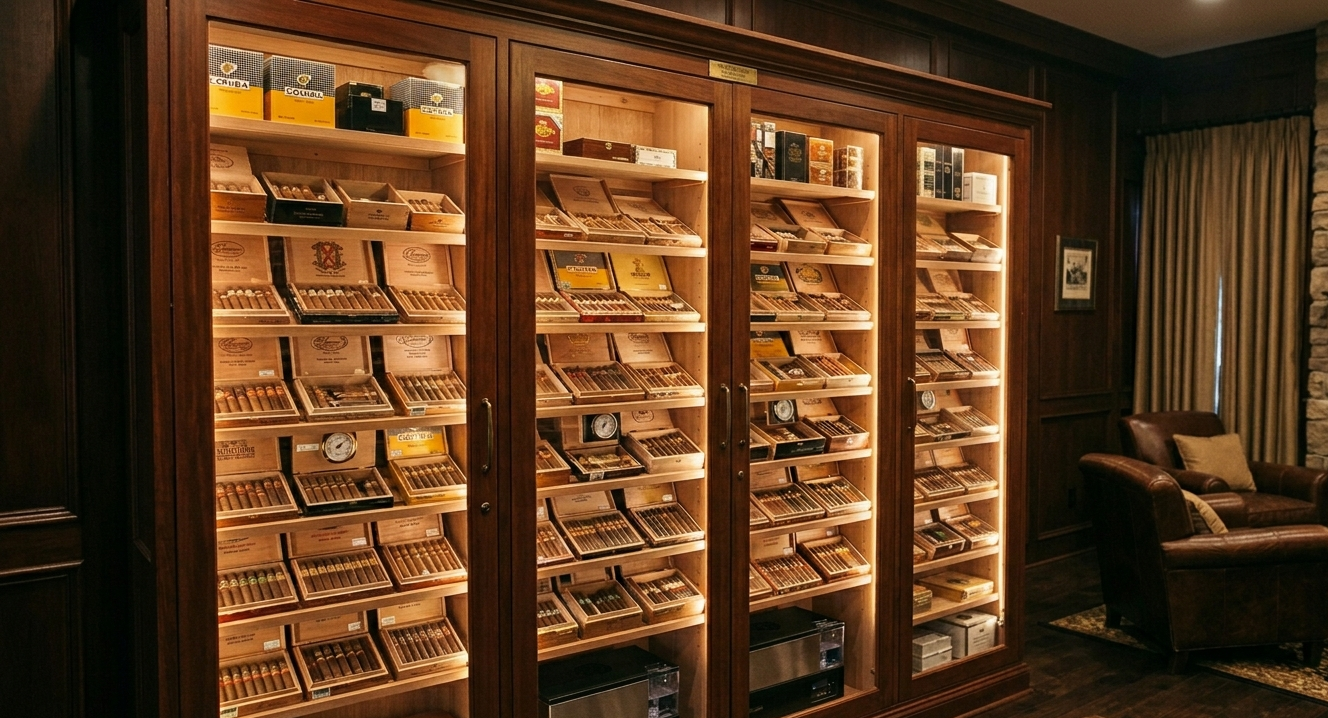
Systems Sized for Walk-In Humidors to Large Commercial Storage Facilities
UltraPure RODI cabinets scale from 75 GPD to 7,500 GPD. Paired humidifier capacity is matched to space volume and target RH setpoint. Whether you’re specifying a single walk-in or a multi-room commercial facility, we’ll size the system to the load, not the other way around.
What you get:
- RODI purification matched to humidifier flow demand
- Patented cabinet design: compact, clean, field-serviceable
- Variable speed fan humidifiers with proportional + dynamic proportional control
- Direct wall-mount installation, no external control box required
- Replacement filters categorized by system (no cross-referencing required)
- Made in the USA
Why Ultrasonic Is Now the Standard in Commercial Humidor Environments
Steam humidification introduces heat, a problem in environments where a stable temperature is as critical as stable humidity. Evaporative systems depend on airflow patterns and require more maintenance. Ultrasonic humidification operates at ambient temperature, delivers immediate output with no warm-up period, and uses significantly less energy than steam alternatives.
When paired with RODI-purified water, ultrasonic humidification eliminates the only traditional drawback of the technology: mineral fallout. That’s why ultrasonic is becoming the default specification for commercial humidors, and why water purity isn’t optional in that spec.
Common Questions from Engineers
Q: What water quality does the humidifier require?
A: Near-zero TDS. Municipal tap water (even filtered) typically contains 150-500 ppm TDS. Our RODI systems produce water below 5 ppm TDS, which is the threshold that eliminates white dust and protects transducer life.
Q: How do I size the RODI system relative to the humidifier?
A: Humidifier demand is determined by room volume, target RH setpoint, and envelope leakage rate. Our team works with you to calculate the required evaporation rate and match the RODI output accordingly. Contact us with your specs, and we’ll size it.
Q: What’s the installation footprint?
A: RODI cabinets are wall-mounted and compact. Humidifiers are wall-mounted with direct duct connection or open-space discharge options. Single-point water connections simplify rough-in.
Q: What does routine maintenance look like?
A: Filter replacement on a scheduled interval (replacement sets are cataloged by system model, no compatibility guesswork). Transducer inspection at annual service. No descaling, no mineral buildup management.
Q: Do you support multi-zone or multi-room installations?
A: Yes. Systems can be specified for single spaces or distributed across multiple zones with individual control. Contact us to discuss your layout.
Ready to Spec the System?
Tell us your space dimensions, target RH, and water source, and we’ll put together a system recommendation with sizing and lead time. Call (800) 729-5192, or submit your project details below.