
Brands We Serve

logo-apple

logo-nasa
logo-aligned-energy

logo-los-alamos

logo1

Toyota-logo

logo6

logo8

logo2

logo9

logo4

logo10

logo5

IT23-IMBA2-030416-company-1

Logo_for_Orbital_ATK

VW-Logo_Tagless_Shawblue_H-1
Humidity Variability on the Manufacturing Floor Is a Yield and Quality Problem
Every manufacturing process has a humidity tolerance. Go below it, and static buildup accumulates on product surfaces, attracts dust, damages electronic components during assembly, and causes soldering defects in PCB production. Go above it, and moisture absorption warps wood, degrades hygroscopic materials, and introduces a risk of condensation on metal components and tooling.
Most facilities address humidity reactively: they add humidification when a problem becomes visible. By then, defect rates have already climbed, the product has been scrapped, and the equipment has absorbed wear that shortens service life.
The engineering problem is not just reaching a target RH. It is holding it precisely and continuously, across variable thermal loads, seasonal ambient shifts, and production line changes, while keeping the humidification system itself from introducing new contamination into the production environment.
Precise, Clean Humidity Across Any Manufacturing Process
UltraPure integrates RODI water purification with industrial ultrasonic humidification to deliver controlled humidity to the production environment without particulate contamination, static risk from mineral-laden mist, or the maintenance burden of steam-based systems. The result is a system that holds its setpoint, protects the process, and runs without constant intervention.
Static Eliminated at the Source.
Electrostatic discharge (ESD) events in electronics manufacturing cause solder defects, component damage, and assembly failures. Maintaining RH at 50% or above substantially reduces static buildup on both product and production equipment. UltraPure ultrasonic humidifiers with RODI-purified water deliver clean moisture to the space without the mineral particulate that untreated water would otherwise introduce onto sensitive assemblies.
Dust Suppressed. Surface Quality Protected.
At 45-50% RH, airborne dust particles absorb moisture and fall out of suspension rather than accumulating on product surfaces. This directly reduces the cleanup time and rework required to achieve an acceptable surface finish, and lowers contamination risk on products where surface quality is a specification requirement. Ultrasonic humidifiers producing 1-micron droplets distribute moisture evenly across the space with no extended absorption distance required.
Product Yield Measurably Improved.
In textile manufacturing, uncontrolled humidity causes moisture loss that reduces material weight and sellable yield. Controlled humidity at setpoint reduces weight loss from a typical 4% to approximately 0.5%, a 3.5 percentage point increase in product yield per production run. Across volume operations, that improvement translates directly to margin. The same principle applies to paper, wood, and other hygroscopic materials, where dimensional stability and weight retention are production specifications.
From Water Source to Production Floor: How the System Works
Step 1: Water Purification
Feed water enters the UltraPure RODI system. Multi-stage reverse osmosis and deionization strip dissolved minerals, chlorine, and contaminants to near-zero TDS. Delivering purified water to the humidifier is what eliminates white dust and protects transducer longevity over the full service life of the installation.
Step 2: Ultrasonic Atomization
Purified water feeds directly to the industrial ultrasonic humidifier. High-frequency transducers produce droplets at approximately 1 micron in diameter: finer than conventional fog systems and small enough for direct space discharge or duct-mounted distribution without extended absorption distance.
Step 3: Proportional Humidity Control
Variable-speed fans and proportional control with dynamic proportional adjustment modulate the humidifier output in real time. The system responds to load changes, occupancy shifts, and ambient variation to hold RH setpoints continuously, without the lag or overshoot that characterizes on/off control. Modbus RTU is built into each humidifier, allowing for remote read-write access to variables. When BACNET is required, UltraPure has an exclusive converter that translates MODBUS to BACNET through ms/tp or IP protocol.
Step 4: Sustained Operation with Predictable Maintenance
Once commissioned, the system runs with minimal intervention. No descaling. No mineral accumulation fouling the transducer array. Replacement filters are cataloged by system model, so maintenance scheduling is straightforward and unambiguous.
Systems Sized for Single-Zone Production Floors Through Multi-Zone Industrial Facilities
UltraPure RODI cabinets range from 75 GPD to 7,500 GPD. Humidifier capacity is matched to space volume, target RH setpoint, and thermal load specific to the production environment. Systems are available in direct space discharge.
What you get:
- RODI purification matched to humidifier flow demand
- 1-micron ultrasonic droplet output for direct space or duct distribution
- Proportional and dynamic proportional humidity control
- Variable speed fans for precise output modulation
- Patented cabinet design: compact, wall-mounted, field-serviceable (US D780,884 S / US D780,885 S)
- Direct wall-mount installation, no external control box required
- Replacement filters cataloged by system model (no cross-referencing required)
- Made in the USA
Configured for the Process, Not Just the Building
Electronics Manufacturing
Static discharge causes solder defects and latent component failures. Maintaining 50% RH during PCB assembly and electronics production substantially reduces ESD events and soldering defects. RODI-purified ultrasonic humidification delivers clean moisture to the assembly environment without introducing mineral particulate onto sensitive boards or components.
Textile Manufacturing
Moisture loss during production reduces material weight and sellable yield. Controlled humidity at setpoint limits weight loss to approximately 0.5%, compared to 4% or more in uncontrolled environments. For high-volume operations, the yield improvement is direct, measurable, and immediate.
Medical Device Manufacturing
Dust contamination and static are both critical concerns in medical device production. Maintaining 45-50% RH suppresses airborne dust and eliminates static buildup on precision components. Clean ultrasonic humidification with RODI water ensures that the humidification system itself introduces no contamination into the production environment.
Wood and Instrument Manufacturing
Dimensional stability in wood and wood-composite materials depends on consistent humidity. Fluctuations cause warping, cracking, joint failure, and tonal instability in acoustic instruments. Tight RH control at setpoint protects material integrity from raw stock through finished product.
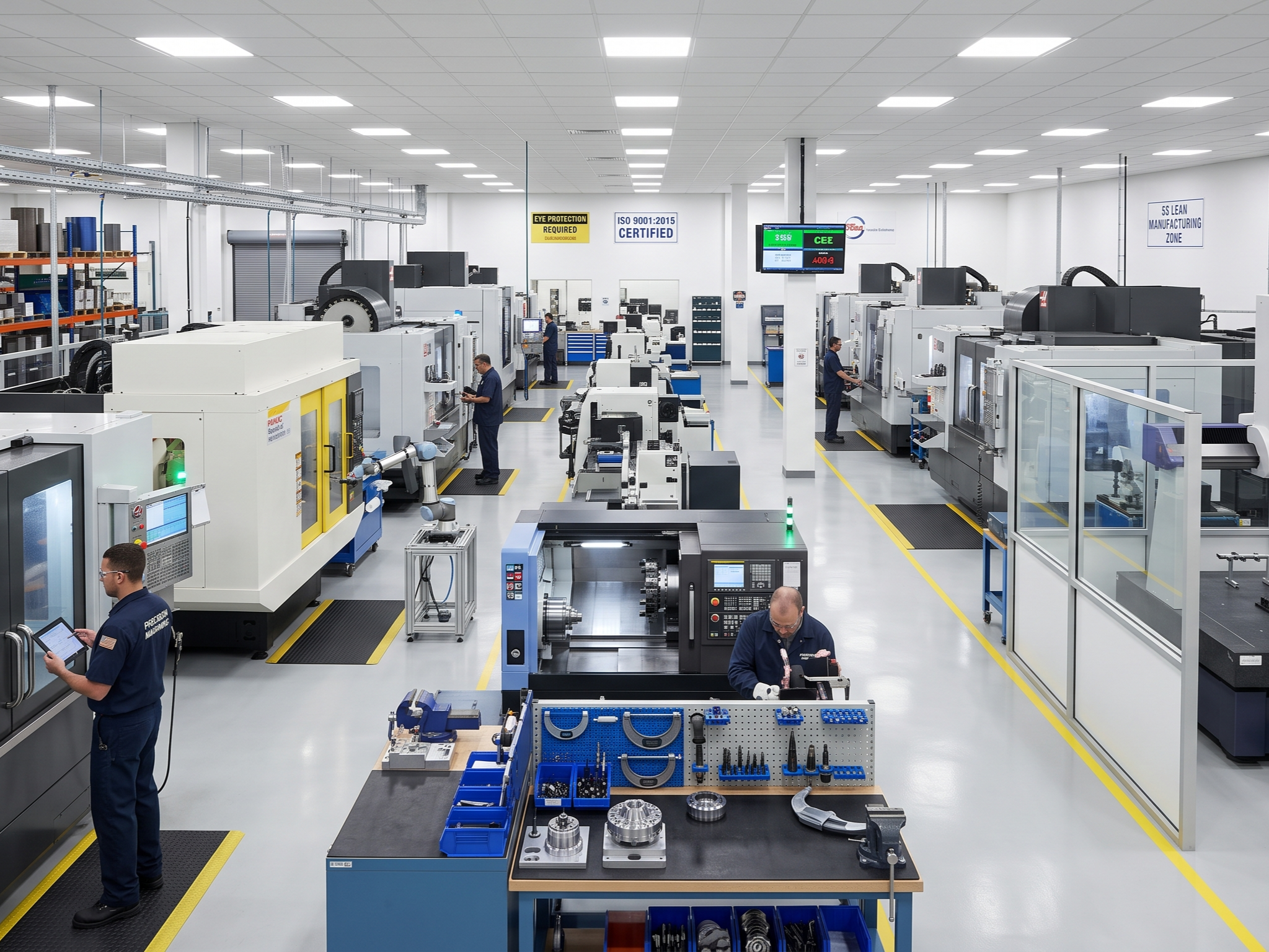
Industrial and High-Precision Machining
Dust accumulation on machined surfaces degrades finish quality and increases post-production cleanup. At 45-50% RH, airborne particulate is suppressed before it can settle on the product. Static buildup that attracts fine metal particles to sensitive surfaces is similarly reduced.
Common Questions from Manufacturing Engineers
Q: Why does water quality matter for an industrial humidifier?
A: Minerals dissolved in tap water or lightly filtered water do not disappear inside a humidifier. They atomize with the water and become airborne particulate. In a manufacturing environment, that means mineral dust settling on product surfaces, assemblies, and equipment. RODI purification removes those dissolved solids before the water reaches the transducer, eliminating the contamination at the source.
Q: What droplet size does ultrasonic humidification produce?
A: Approximately 1 micron. This is significantly smaller than conventional fog systems, which require an extended absorption distance due to larger droplet size. The 1-micron output is suitable for direct space discharge or duct-mounted distribution without wetting surfaces near the unit.
Q: What RH setpoint is recommended for electronics manufacturing?
A: 50% RH is the standard target for reducing ESD events and soldering defects in electronics assembly. The system maintains this setpoint through proportional control with dynamic proportional adjustment, without overshoot or the lag that causes RH to drift below threshold during production load changes.
Q: Can the system handle multiple production zones with different RH requirements?
A: Yes. This is an important aspect of the Si6ma ultrasonic humdifier. With a built in humidistat on each humdifier that allows for independent control of the RH and setpoint allowing for different zones and/or other areas to be controlled independently.
Q: How does this compare to steam humidification for a manufacturing environment?
A: Steam humidification adds heat load to the production environment, which conflicts with temperature-controlled processes and increases cooling demand. It also requires continuous energy input for boiling and periodic descaling for mineral accumulation in the steam generator. Steam humidifers utilize power from the grid until boiling point 212° is obtained whereas Ultrasonic humidifcation has instant humidity the moment the system calls for humidity.
Ultrasonic humidification operates at ambient temperature, adds no heat load, and, with RODI-purified water, requires no descaling. Maintenance is reduced to scheduled filter replacement.
For every 1 pound of water consumed using Isothermal humidifcation 1,000btu of (heat) is added into the space
For every 1 pound of water consumed using Ultrasonic humidifcation 1,000btu of (heat) is extracted from the space
Q: What does the maintenance schedule look like?
A: Scheduled filter replacement (sets are cataloged by system model, no cross-referencing required) and annual transducer inspection. No descaling, no steam system boiler maintenance, no mineral accumulation management.
Ready to Spec the System for Your Facility?
Send us your production environment type, space dimensions, target RH setpoint, number of zones, and water source. We will put together a system recommendation with sizing and lead time. Call (800) 729-5192, or submit your project details below.